
Cold Laser Therapy for Back, Neck and Shoulder Pain
If your back, neck or shoulders are the first thing to complain after a long drive, a day at the desk or a weekend on the mountain, you are in good company. They are where many LumaCare customers reach for the Duo first. People use cold laser therapy for back, neck and shoulder pain as a drug-free way to support comfort and keep moving, usually in a quiet 10 to 20 minute session on the couch.
The LumaCare Duo is a patented dual-head, cordless cold laser (also called low-level laser therapy, or LLLT) you run yourself at home. Here is why these areas are tricky, how people use the Duo on them, what the research says, and who should check with a doctor first.
Why the back, neck and shoulders are hard to treat
The muscles here are thick and layered, so surface-only approaches rarely reach where the tightness lives. The joints are deep: the facet joints along the spine, the discs between vertebrae, and the ball-and-socket of the shoulder with its cuff of four small tendons. And everything is connected, so a stiff neck shows up as a sore shoulder and a tight hip as low back ache.
That is where two heads help. The Duo’s pivoting heads cover both sides of the spine at once, or wrap the front and back of a shoulder in the same session, so the joint gets light from two angles instead of one. Each head carries 15 emitters (10 laser diodes and 5 LEDs) in three wavelengths: 905 nm and 808 nm lasers for deeper tissue and 670 nm red LEDs for the surface, with 75 W combined peak power.
How people use the Duo on the back, neck and shoulders
The Duo has three settings, Skin, Muscle and Joint, which change the pulse pattern to suit how deep the target sits. This is general guidance, not a prescription; follow the user manual and your own comfort.
- Lower back: The Muscle setting, one head on each side of the spine. For a deeper ache that feels like it sits in the joints, many switch to the Joint setting and angle the heads inward.
- Upper back and shoulder blades: The Muscle setting with the heads spread across the traps and rhomboids. Lie back on a pillow with the heads in place; the Duo is cordless with a 10-hour battery, so there is no cable to fight.
- Neck: The Muscle setting along the sides and back of the neck. Keep the heads below the skull line and never aim the emitters at the eyes.
- Shoulder: The Joint setting, one head on the front of the shoulder and one on the back or top, so the rotator cuff area gets light from two sides.
Many users do 10 to 20 minutes per area, often daily for a couple of weeks before easing off to a few times a week. There is no heat and nothing to feel, and most people report that any change in comfort shows up over days rather than instantly.
What the research says
Light in these wavelengths has been studied for decades under the name photobiomodulation. None of these trials used the LumaCare Duo, and results vary with dose and technique, so read them as context rather than promises.
- Neck pain. A meta-analysis of 16 randomised trials (820 patients) found that low-level laser therapy reduced neck pain more than placebo in both acute and chronic cases, with benefit lasting into the medium term and side effects similar to placebo. Chow et al., The Lancet, 2009.
- Chronic low back pain. A 2015 meta-analysis pooled seven randomised trials (394 patients) and found laser therapy lowered pain scores compared with placebo after treatment, with less clear results for disability and range of motion. Huang et al., Arthritis Research & Therapy, 2015.
- Shoulder tendinopathy. A review of 17 randomised trials found that laser therapy at adequate doses relieved shoulder pain better than placebo, alone and alongside physiotherapy, while underdosed treatment did not help. Haslerud et al., Physiotherapy Research International, 2015.
Who it’s for, and who should talk to a doctor first
The Duo is designed for active adults who want a non-invasive option to support comfort: a tight lower back from sitting, a cranky shoulder from golf or paddling, a neck that stiffens after screen time. It is FDA cleared and a Class 1 laser, the lowest laser safety classification.
Please talk to your doctor before using cold laser therapy if any of these apply:
- You are pregnant, or you have a pacemaker or implanted device near the treatment area.
- You have had cancer in or near the area you want to treat.
- Your pain came with numbness, weakness, loss of bladder or bowel control, fever, or followed a fall or accident.
- You take photosensitising medication or have a light-sensitivity condition.
Cold laser therapy is meant to complement your care, not replace it. Many people use it alongside physical therapy, stretching and chiropractic visits.
Frequently asked questions
Can I use the Duo on my own back?
Lower back and shoulders are easy to reach yourself. For the upper back, lie on the device with the heads on a pillow, or ask a partner to hold it.
How long before I notice anything?
Some people notice a change within a few sessions; others take two or three weeks of consistent use. The 60-day guarantee lets you find out with no risk.
Is it safe to use every day?
Many users do a daily session for a couple of weeks, then taper. Follow the manual, and never direct the emitters at the eyes.
Does it help with rotator cuff pain?
Many people use the Joint setting on the shoulder for that, treating the front and back of the joint at once. If you have a confirmed tear, ask your orthopedist first.
Looking for other areas? See how people use the Duo for hand, wrist and elbow pain and knee, ankle and foot pain.
Light for Real Life
The LumaCare Duo has been designed and assembled in the USA since 2018. During our year-end factory-direct release it is $997 instead of the $1,795 list price, and every unit ships with a 3-year limited warranty and a 60-day money-back guarantee, so you can try it on your own back, neck and shoulders and decide for yourself. It is also HSA and FSA eligible. Get the LumaCare Duo now and get back to the life you don’t want to be slowed down from.
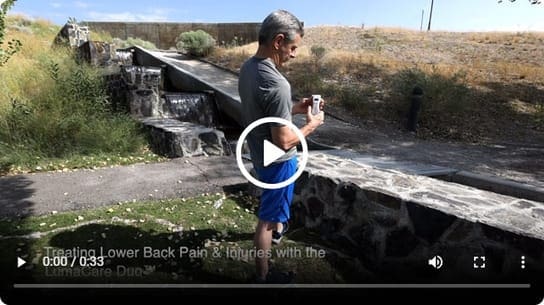
Treating Lower Back Pain & Injuries with LumaCare Duo
Video Transcript
In this video, we are demonstrating how to treat a lower back injury.
The red lights will begin to pulse immediately, sending treating light directly to your injured lower back.
And that’s how the LumaCare Duo is used to help reduce pain and shorten the amount of time for healing a lower back injury.