

While most of us do long-form writing using a keyboard, there are occasions when using a pen or pencil becomes a necessary (even the preferred) way to write.
You might discover your hands start to hurt not too far into your task. Even with a computer, typing for an extended amount of time can cause hand pain.
What are some successful ways to relieve hand pain from writing? Depending on the severity of your hand pain, natural and inexpensive methods can offer great relief. If hand dystonia, carpal tunnel syndrome, or other medical condition causes your pain, you may require surgery or medication.
Many writers have found relief using alternative treatments such as low-level laser therapy (Lllt therapy), also known as photo biomodulation therapy.
Read further to learn how to relieve pain in your hand from writing.
What Causes Pain When Writing?
The wrong placement of the writing utensil in the hand is most often the cause of pain from writing. Also, pressing down too hard on paper (or on a keyboard) can lead to muscle strain, muscle spasms, and acute pain in the hand that is writing. More serious muscle and/or nerve issues, however, also could be the root of the issue.
Consult with your physician regarding any hand pain you experience, whether it is acute pain or chronic pain.
Simple Ways to Get Immediate Hand Pain Relief
You can relieve hand pain from writing by changing your writing utensil, adjusting how you are holding the pen, and relaxing your hand at varying intervals. Let’s examine this more fully:
Writers can achieve hand-pain relief just by choosing a rollerball pen. This pen-type will help you write more smoothly and requires less pressure while composing. If you have large hands, the thickness of your pen may also impact the stress placed on your hand muscles. A person with large hands may need to use a writing utensil with a thick body and no edge or grip to restrict hand placement.
How are you holding your pen?
Experts recommend the three-point grip to avoid muscle cramps. The thumb and forefinger grip the pen, placed on the front part of the middle finger. Then the thumb and forefinger guide the pen.
Use your wrist and forearm to move your pen or pencil rather than using your fingers.
Consider cursive writing rather than printing. Large, cursive style writing reduces strain.
Take a break every 5 or 10 minutes and lay down the pen. Flex your hand muscles. Take a few minutes to review what you’ve written or simply give your hands a moment to be still.
Photobiomodulation For Hand Pain Relief
Laser therapy is a non-invasive method that reduces inflammation and contributes to pain relief caused by many health conditions, hand pain among them. Light-emitting diodes stimulate cell function in the area where a device, such as the LumaCare Duo, is applied. The LumaCare Duo is a fantastic, non-invasive treatment option for hand pain.
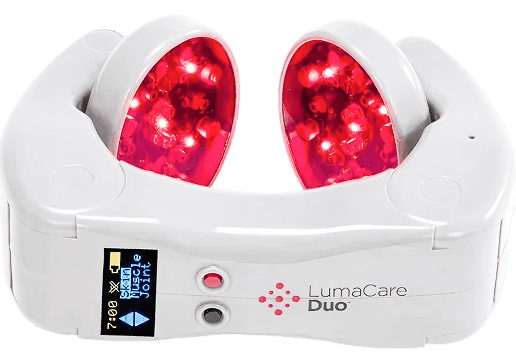
The light emitted by the diodes penetrates the skin and is absorbed by mitochondria. This creates adenosine triphosphate (ATP) – the energy-carrying molecule in cells. ATP drives muscle contraction, the spread of nerve impulses, and other related processes that impact how we “experience” pain and how our bodies react to an injury. ATP reacts to the low-level light of photobiomodulation, which causes internal pain mediation.
PMB therapy improves soft tissue healing, reduces inflammation, and relieves acute and chronic pain.
Sometimes hand pain results from tendinitis, an inflammation of the tissue that attaches muscles to the bones. Low-level laser therapy/PMB may hasten recovery from tendinitis.
Clinicians in the PMB field advocate using devices such as LumaCare Duo to help reduce inflammation at the wrist and hand. LumaCare Duo can be used safely at home or administered by a clinician.
Surgery for Hand Pain Relief
You should consult a physician if any writing is painful, especially if the pain persists or is extreme.
The Mayo Clinic recommends you see your health care provider if you have signs and symptoms of carpal tunnel syndrome that interfere with your normal activities and sleep patterns. Permanent nerve and muscle damage can occur without treatment.
Likewise, if you experience symptoms of hand dystonia, which is a neurological movement disorder, consult your physician to see if PMB therapy may be an alternative treatment to conventional surgeries or botulinum toxin (botox) injections.