
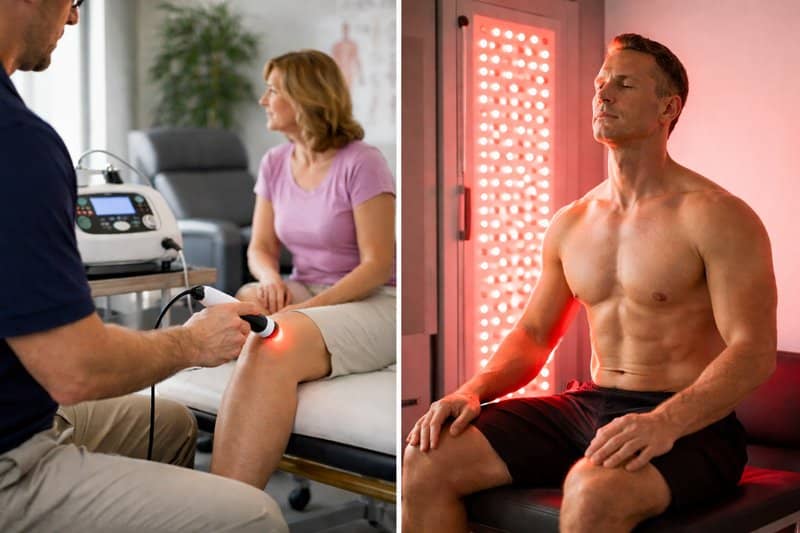
Cold laser therapy and red light therapy often appear side by side in conversations about light-based wellness, but they aren’t interchangeable. While both use light instead of heat, compression, or medication, they deliver that light in different ways and with different goals. As a result, each treatment is its own distinct tool.
If you’re trying to decide which option works best for your needs, don’t confuse the two. Because they both use light, it’s easy to assume they offer the same experience or results. That assumption can lead to confusion or mismatched expectations.
Let’s explore the differences between cold laser therapy and red light therapy so you can understand when to choose one over the other.
What is Cold Laser Therapy?
Cold laser therapy devices for pain relief or healing work by shining a low-level laser light on a specific area of your body. The light is very precise wavelengths, allowing it to target tissues beneath your skin. Each wavelength targets a different depth, allowing you to select a wavelength that aligns with your specific needs.
When the light hits your cells, it delivers energy that your cells can use to work more efficiently. It doesn’t cut or heat your body. Instead, it gently and noninvasively guides your cells to perform their natural functions more effectively.
During a typical session, you or someone else simply holds the laser over the area you want to target for three to seven minutes. The focused light allows the therapy to concentrate on the exact spot that needs attention, rather than affecting the surrounding tissue.
Because the light is so targeted, cold laser therapy is well-suited for joints, tendons, recovering surgical sites, or other specific areas of discomfort.
What is Red Light Therapy?
Red light therapy uses light-emitting diodes (LEDs) rather than lasers. These lights produce red or near-infrared wavelengths that spread over a larger surface area, instead of a single concentrated spot.
Red light therapy setups often involve panels, lamps, or full-body devices. You position yourself near the light source and remain still for a set period. As a result, the experience tends to feel ambient and passive rather than targeted.
Similar to cold laser therapy, red light therapy stimulates cellular activity. However, because it disperses light over a wider area, treatments are better suited for general wellness, muscle recovery, and ongoing maintenance. Red light therapy is typically incorporated into broader routines that support overall cellular health through consistent, repeated exposure.
Key Differences in Light Delivery and Design
The primary difference between red light therapy and cold laser therapy lies in the delivery of the light. As we discussed, cold laser therapy uses a concentrated beam aimed at a specific location. Red light therapy disperses light to cover a wider area at once.
These delivery methods influence the structure of treatment sessions. The placement of cold laser therapy is critical because of the focused light. If you’re pointing the light at the wrong area, it won’t do anything. Red light therapy positioning, on the other hand, involves distance and coverage rather than pinpoint accuracy.
Another difference involves the equipment itself. Cold laser therapy devices are typically handheld to aid in precision. Red light therapy devices, however, are often panels or larger fixtures that provide much broader light exposure. These physical distinctions shape how each approach fits into different settings and routines.
How You Might Use Each Approach
With cold laser therapy, the focus is on precise healing. You position the device over a specific area, such as a joint, tendon, or small muscle group that’s giving you trouble. You then hold it in place for several minutes at a time.
Sessions are typically short (three to seven minutes), but deliberate. You may repeat the treatment on the same area across multiple sessions, depending on your routine and how persistent your condition is. Focus on the spots that matter most to you.
Red light therapy, in contrast, covers broader areas. You might use a panel or lamp to expose larger regions of your body, such as your back, shoulders, or legs. Sessions can last longer than cold laser treatments, and the emphasis is on consistency rather than exact placement. Many people incorporate red light therapy alongside stretching, mobility exercises, or other general recovery and wellness practices.
Both approaches are flexible and non-invasive, meaning you can fit them into your schedule without disrupting other activities.
Choosing the Right Treatment for You
When deciding between cold laser therapy and red light therapy, focus on practical considerations that align with your goals and lifestyle. Think about how much time you want to dedicate to each session and whether you aim to target specific areas or cover broader regions. Would a full red light therapy device fit into your space, or would you prefer a handheld cold laser therapy device?
If you experience pain in specific joints or muscles, or if you’re recovering from surgery, cold laser therapy is likely the best option for you. It gives you precise control over where you apply the light.
Cold laser therapy sessions allow you to maximize focus on specific areas in minimal time, fitting right into your schedule. Because red light therapy sessions are typically longer, you may need to plot out time within your day for sessions.
Decide your priorities. Are they precision, convenience, routine integration, or speed? Use your research to make the choice that fits your needs. Choose what will help you get the most from your light-based wellness approach and bring you closer to comfort and relief.